
Commonwealth v. Stoney: Does Touching Your Waistband Give Police Reasonable Suspicion for a Gun Stop?
June 27, 2026
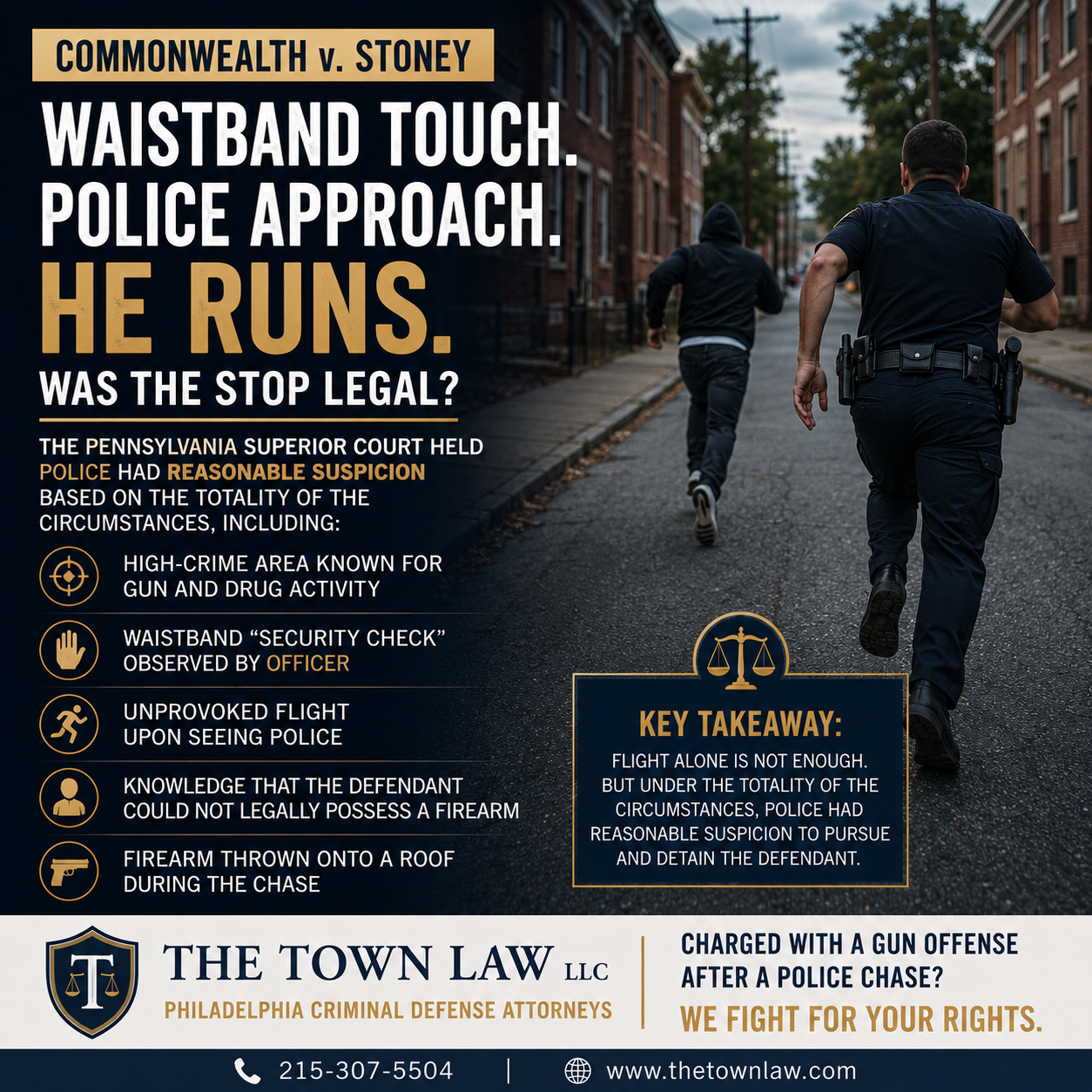 Many Pennsylvania gun cases begin the same way.
Police see someone on the street.
They believe the person may have a gun.
The person touches or adjusts the waistband.
Police approach.
The person runs.
A firearm is later recovered.
The legal question is often:
Did police have reasonable suspicion before the chase?
That issue was at the center of Commonwealth v. Terry Lyndell Stoney, a published 2025 Pennsylvania Superior Court decision involving a police street encounter, alleged waistband “security check,” flight, a firearm tossed onto a roof, and probation officers helping police apprehend the suspect.
The Superior Court affirmed the denial of suppression and held that police had reasonable suspicion to stop and detain Stoney under the totality of the circumstances.
The case is important for Pennsylvania firearm cases because it addresses two common defense issues:
When does police pursuit become a seizure?
And:
Can probation officers help police chase and detain someone who is not on county probation?
What Happened in Commonwealth v. Stoney?
The case began on May 9, 2022, around 4:00 p.m. in Harrisburg.
A Harrisburg police officer was working with the Street Crimes Unit. He was partnered that day with several Dauphin County Adult Probation Officers.
While driving near North 6th and Seneca Streets, the officer saw two men standing on the southwest corner. The officer described the location as a high-crime, high-drug area known for gun and violent crime.
The two men were later identified as Terry Stoney and Dupree Holmes.
According to the officer, Holmes appeared to have a large heavy object in the front middle area of his body. The officer believed it looked like a firearm with a drum magazine.
The officer also testified that he saw Stoney use his right hand to tap an object in his front waistband. Based on the officer’s training and experience, he believed this was consistent with someone carrying a concealed firearm in the waistband.
This is sometimes described by police as a “security check.”
In plain English, police use that phrase when they believe someone is touching, patting, or adjusting a concealed weapon to make sure it is still secure.
The Police Approach
After observing the two men, the officer drove around the block, parked, and the officers got out.
They approached Stoney and Holmes from behind.
The officer said something like:
“Hey fellas.”
The men turned, saw the officers, and fled in opposite directions.
The officer chased Holmes. The adult probation officers pursued Stoney.
During the chase, one probation officer testified that he saw Stoney pull a firearm from his waistband and throw it onto a roof.
That probation officer also knew Stoney from prior supervision and knew Stoney was not permitted to possess a firearm because of his prior record.
Stoney and Holmes were eventually arrested after brief chases.
With the help of the fire department, officers recovered the firearm from the roof.
The Charges
A jury convicted Stoney of:
Persons not to possess firearms;
Carrying a firearm without a license; and
Disorderly conduct — creating a hazardous or physically offensive condition.
The trial court sentenced him to an aggregate term of 80 to 160 months in prison.
Stoney appealed, arguing that the firearm should have been suppressed.
The Suppression Argument
Stoney raised two major suppression issues.
First, he argued that police lacked reasonable suspicion to seize him.
Second, he argued that the county probation officers acted outside their authority because he was not on county probation when they pursued and apprehended him.
The Superior Court rejected both arguments.
Issue One: When Was Stoney Seized?
The first major issue was determining when the seizure happened.
That matters because police do not need reasonable suspicion for a mere encounter, but they do need reasonable suspicion for an investigative detention.
A mere encounter is a police-citizen interaction where the person is free to ignore the officer and keep going.
An investigative detention is a temporary seizure. At that point, police need reasonable suspicion that criminal activity is afoot.
Stoney argued that he was seized when the officer called out “hey fellas.”
The Superior Court disagreed.
The Court held that saying “hey fellas” was not a command, not a show of force, and not the kind of police conduct that would make a reasonable person believe he was not free to leave.
In other words, the Court treated that moment as a mere encounter.
The seizure happened later — when Stoney fled and the officers began pursuing him.
That is important because Pennsylvania law treats police pursuit of a fleeing person as a seizure for constitutional purposes.
Why “Hey Fellas” Was Not Enough
The Court looked at whether the officer’s words and conduct would communicate to a reasonable person that he was not free to leave.
The officer did not draw a weapon.
He did not physically touch Stoney.
He did not issue a command like “stop” or “come here.”
He did not block Stoney’s path.
He merely said something like “hey fellas.”
Under those facts, the Court held the encounter had not yet escalated into a seizure.
That distinction is important in street-stop cases.
Police can generally approach someone and attempt to speak with them without creating a seizure. But if police use force, commands, physical blocking, threatening presence, or other coercive conduct, the interaction may become an investigative detention requiring reasonable suspicion.
Issue Two: Did Police Have Reasonable Suspicion?
Once Stoney ran and the officers pursued him, the Court had to decide whether reasonable suspicion existed.
The Superior Court held that it did.
The Court relied on the totality of the circumstances, including:
The area was described as high-crime and high-drug;
The area was known for gun and violent crime;
Holmes appeared to have a large object consistent with a firearm with a drum magazine;
Stoney touched his waistband in a manner the officer believed was a security check;
The officer believed Stoney may have been carrying a concealed firearm;
A probation officer knew Stoney was not permitted to possess a firearm;
And Stoney fled after seeing the officers.
Taken together, the Court held those facts supported reasonable suspicion.
Flight Alone Is Not Always Enough
This case does not mean that running from police automatically proves criminal activity.
Flight is an important factor, but context matters.
The defense should always ask:
What happened before the flight?
Did police see actual criminal activity?
Did police see a firearm?
Was there a bulge?
Was there a waistband movement?
Was the person in a high-crime area?
How specific was the officer’s testimony?
Did the person run before or after police showed authority?
Was there body camera footage?
Did the officer’s testimony match the video?
In Stoney, the Court did not rely on flight alone.
The Court relied on flight combined with suspected firearm possession, the alleged security check, the high-crime area, and the officer’s knowledge that Stoney could not legally possess a gun.
What Is a Waistband “Security Check”?
A waistband “security check” is a phrase police often use in gun cases.
It usually means police claim they saw someone touch or pat the waistband area in a way that suggested the person was checking the location of a concealed firearm.
This can be powerful evidence for the Commonwealth.
But it can also be challenged.
A person may touch his waistband for many innocent reasons:
Adjusting clothing;
Holding up pants;
Reaching for a phone;
Reacting nervously to police;
Moving naturally while walking;
Carrying ordinary items;
Or simply making a movement that police later interpret as suspicious.
The defense should not automatically accept the phrase “security check” at face value.
A good defense analysis should ask:
What exactly did the officer see?
How many times did the person touch the waistband?
Was there a visible bulge?
Was the movement clear on video?
Could it have been innocent?
Did the officer write it in the report immediately?
Did the officer use boilerplate language?
Did the person actually possess a firearm when stopped?
Did police recover the gun from the person or somewhere else?
In Stoney, the Court accepted the officer’s testimony as part of the reasonable suspicion analysis.
But in another case, weaker or vague testimony about a “security check” may not be enough.
Issue Three: Could Probation Officers Help Police Chase Him?
The second major legal issue involved the role of the adult probation officers.
Stoney argued that the county probation officers lacked authority to chase and seize him because he was not under county supervision.
He also argued that the probation officers were improperly acting as police officers.
The Superior Court rejected that argument.
The Court discussed prior Pennsylvania case law involving parole and probation officers, including the concept that probation and parole officers may have certain authority to act for safety and supervision-related reasons.
The Court also discussed the “stalking horse” doctrine.
What Is the “Stalking Horse” Doctrine?
The “stalking horse” doctrine generally refers to a situation where probation or parole officers are used as a tool for police to avoid the normal warrant or probable cause requirements.
In other words, police cannot simply use probation officers as a workaround to do what police could not legally do themselves.
That doctrine can matter when probation officers conduct searches that are really police searches in disguise.
But the Superior Court held that this was not a stalking horse case.
Why?
Because the police officer already had reasonable suspicion to stop and detain Stoney.
The probation officers were not being used to bypass the Fourth Amendment. They were assisting in physically apprehending a fleeing suspect after reasonable suspicion already existed.
The Court stated that Stoney did not point to authority showing that probation officers cannot help a police officer apprehend a fleeing suspect when the police officer has reasonable suspicion and cannot physically do so himself.
Why the Probation Officer Issue Matters
This part of the case is important because police often work with probation, parole, and specialized enforcement units.
In serious gun and drug cases, a person may encounter:
Local police;
Street crime units;
County detectives;
Adult probation officers;
State parole agents;
Federal probation officers;
Task force officers;
Or mixed law enforcement teams.
When different agencies are involved, the defense should always examine authority and purpose.
Important questions include:
Who initiated the investigation?
Was the person on probation or parole?
Was the officer acting as a probation officer or as a police officer?
Was probation used to avoid a warrant?
Did the police already have reasonable suspicion or probable cause?
Was there a probation search condition?
Was the search supervision-related or criminal-investigation-related?
Did probation merely assist in safety or apprehension?
Was the person actually under the supervision of that agency?
In Stoney, the Court held the probation officers did not violate the law by assisting in the chase.
The Court’s Holding
The Pennsylvania Superior Court affirmed the judgment of sentence.
The Court held:
The officer saying “hey fellas” was a mere encounter, not a seizure.
Stoney was seized when he fled and officers began pursuing him.
At that point, police had reasonable suspicion based on the totality of the circumstances.
The alleged waistband security check, suspected firearm possession, high-crime area, unprovoked flight, and knowledge that Stoney could not possess a firearm supported the stop.
The firearm was not suppressed.
The probation officers did not unlawfully act as stalking horses.
The probation officers could assist police in apprehending a fleeing suspect where police already had reasonable suspicion.
Why This Case Matters for Pennsylvania Gun Charges
This case matters because many gun possession cases begin with police observing a waistband movement, approaching, and then chasing someone who runs.
If a gun is later found, the case often turns on whether police had reasonable suspicion before the pursuit.
The Commonwealth may argue:
The person made a security check;
The person was in a high-crime area;
The officer saw a bulge;
The person fled;
The person discarded the gun;
The firearm was abandoned;
And the police chase was lawful.
The defense may argue:
The waistband movement was innocent;
The high-crime-area testimony was vague;
Flight alone was not enough;
Police created an unlawful seizure;
The discarded firearm was the product of illegal police pursuit;
And the firearm should be suppressed.
Stoney is a Commonwealth-friendly case, but it also shows exactly where the defense needs to focus.
The Defense Takeaway
The defense takeaway from Commonwealth v. Stoney is that suppression issues in gun cases are highly fact-specific.
A strong suppression challenge should examine:
When did the seizure actually happen?
Was it a mere encounter or an investigative detention?
What exactly did police say?
Did police issue commands?
Did police block the person’s movement?
Did police display weapons?
What did police see before the chase?
Was there a visible firearm or only a suspected bulge?
Was the waistband movement actually suspicious?
Was the officer relying on boilerplate “security check” language?
Was the area truly high crime?
Was the high-crime testimony specific or vague?
Did the officer know the person was prohibited from possessing a firearm before the chase?
Did the person discard the firearm before or after the unlawful seizure?
Were probation or parole officers properly involved?
Was the stalking horse doctrine implicated?
Was there body camera footage?
These details can determine whether the firearm comes into evidence.
The Key Takeaway
The key takeaway from Commonwealth v. Stoney is this:
Police may have reasonable suspicion to pursue someone when a suspected firearm, a waistband security check, high-crime-area evidence, knowledge that the person cannot legally possess a gun, and flight are all present under the totality of the circumstances.
But that does not mean every chase is legal.
And it does not mean every waistband movement justifies a stop.
The Commonwealth still has to prove the facts that made the stop lawful.
If police found a gun after a chase, the defense should carefully review whether the pursuit was supported by reasonable suspicion before the evidence was recovered.