
Simple Possession vs. Possession With Intent to Deliver in Philadelphia
May 1, 2026
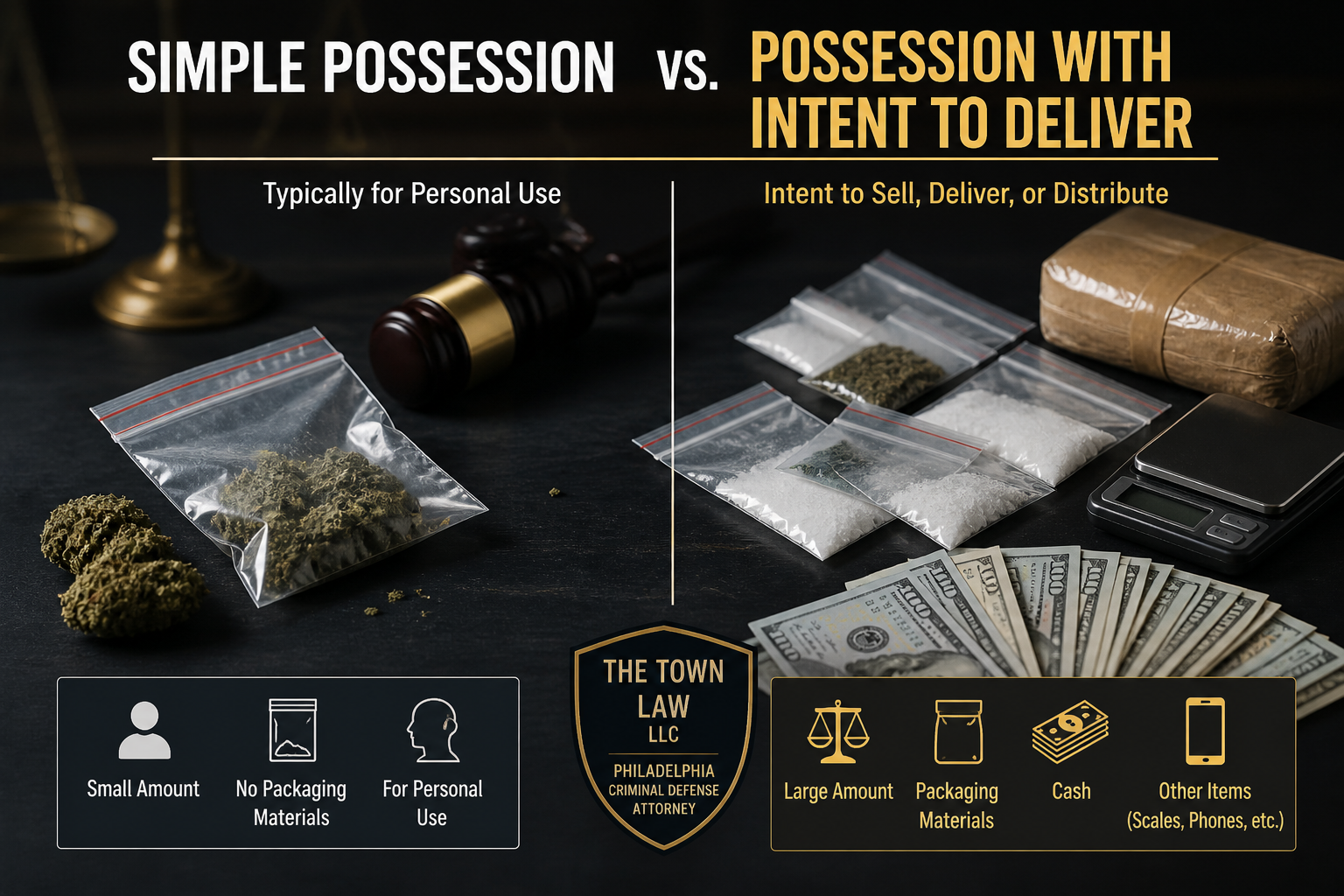 If you were arrested for drugs in Philadelphia, one of the most important questions is whether the charge is simple possession or possession with intent to deliver, often called PWID.
That difference matters.
A simple possession case usually means the Commonwealth is accusing someone of possessing drugs for personal use. A PWID case means the Commonwealth is accusing someone of possessing drugs with the intent to sell, deliver, or distribute them.
Those two charges can look similar at first. Both may involve drugs found in a car, a house, a pocket, a bag, or during a police search. But the consequences, strategy, and risk level can be very different.
In Philadelphia, drug charges are serious. A drug conviction can affect your freedom, record, employment, schooling, housing, immigration status, professional licensing, and future opportunities. If the case is charged as possession with intent to deliver, the stakes may be much higher.
The good news is that the charge filed by police is not always the charge the Commonwealth can actually prove. In many drug cases, the defense may challenge the stop, the search, the alleged possession, the lab testing, the weight, the packaging, or the claim that the drugs were intended for delivery.
What Is Simple Possession in Philadelphia?
Simple possession generally means the Commonwealth is accusing a person of knowingly or intentionally possessing a controlled substance without a valid prescription or legal authorization.
Under Pennsylvania’s Controlled Substance, Drug, Device and Cosmetic Act, simple possession is addressed under 35 P.S. § 780-113(a)(16). The statute prohibits knowingly or intentionally possessing a controlled or counterfeit substance unless the person is properly authorized or has a valid prescription.
In plain English, simple possession usually means the government is claiming:
the substance was an illegal controlled substance;
the person knew the substance was there;
the person had actual or constructive possession of it;
and the person did not have legal authorization to possess it.
Simple possession cases can involve substances such as marijuana, cocaine, heroin, fentanyl, pills, prescription medication without a valid prescription, or other controlled substances.
But possession is not always obvious. Police may charge someone even when drugs were not found directly on that person. For example, drugs may be found in a car, backpack, bedroom, purse, center console, or shared space. In those situations, the Commonwealth may have to prove constructive possession, meaning the person had the power and intent to control the drugs.
What Is Possession With Intent to Deliver in Philadelphia?
Possession with intent to deliver is more serious.
PWID generally means the Commonwealth is accusing someone of possessing a controlled substance with the intent to manufacture, deliver, sell, distribute, or transfer it. Pennsylvania law addresses possession with intent to deliver under 35 P.S. § 780-113(a)(30). That section prohibits manufacturing, delivering, or possessing with intent to manufacture or deliver a controlled substance by a person not properly authorized to do so.
In plain English, PWID usually means the prosecution is trying to prove:
the person possessed a controlled substance;
the person knew what it was;
and the person intended to deliver or distribute it to someone else.
The key issue is often intent.
Police may find drugs and assume they were not for personal use. But an assumption is not the same as proof. The defense may challenge whether the evidence actually shows intent to deliver or whether the case is more properly treated as simple possession.
Why the Difference Matters
The difference between simple possession and possession with intent to deliver can affect everything about the case.
A simple possession case may involve lower exposure, different negotiation options, possible diversionary programs, treatment-focused resolutions, or opportunities to protect the person’s record depending on the facts and prior history.
A PWID case can carry much more serious consequences. Prosecutors may treat it as a drug-dealing case rather than a personal-use case. PWID cases may involve felony exposure, higher sentencing risk, more aggressive prosecution, search warrants, surveillance, confidential informants, alleged controlled buys, lab testing, cell phone evidence, and claims about packaging or cash.
That is why it is not enough to ask, “Were drugs found?”
The better questions are:
Where were the drugs found?
How much was recovered?
How were the drugs packaged?
Was there cash?
Were there scales, baggies, or other items?
Did police claim they observed a transaction?
Were there text messages or phone evidence?
Was anyone else present?
Was the search legal?
Can the Commonwealth prove possession?
Can the Commonwealth prove intent to deliver?
How Police Decide Whether to Charge PWID
Police and prosecutors often look at several factors when deciding whether to charge possession with intent to deliver instead of simple possession.
Those factors may include:
the amount of drugs;
how the drugs were packaged;
whether there were multiple small bags or packets;
whether there was a scale;
whether there were unused baggies;
whether there was a large amount of cash;
whether police claim they observed hand-to-hand transactions;
whether there were messages suggesting sales;
whether multiple phones were recovered;
whether the person had prior drug-related history;
whether the drugs were found in a location associated with distribution;
whether anyone made statements;
and whether police believe the facts are inconsistent with personal use.
But none of these factors automatically prove PWID.
For example, cash can have innocent explanations. Packaging can be consistent with how drugs are purchased, not necessarily how they are sold. A person may have a substance-use problem rather than an intent to deliver. Text messages can be misread or taken out of context. Police may exaggerate what they observed.
The defense should review each alleged factor carefully.
The Amount of Drugs Matters, But It Is Not Everything
The amount of drugs recovered is often one of the biggest issues in a PWID case.
If police recover a very small amount of a controlled substance, the defense may argue the case is consistent with personal use. If police recover a large amount, the Commonwealth may argue it is more consistent with distribution.
But amount alone does not always answer the question.
A person struggling with addiction may possess more than a small amount for personal use. Someone may buy in bulk to avoid repeated street purchases. The substance may be shared among people. Police may overstate the significance of weight without considering context.
The prosecution may use an expert witness to argue that the amount and circumstances are consistent with intent to deliver. The defense may challenge the assumptions behind that opinion.
Packaging Can Be Misleading
Packaging is another common issue.
Police often argue PWID when drugs are divided into small bags, packets, bundles, capsules, or containers. Prosecutors may claim that separate packaging shows the drugs were prepared for sale.
But packaging does not always prove intent to deliver.
Many people buy drugs already packaged that way. The fact that drugs are separated does not automatically prove the person charged packaged them or intended to sell them. The defense may argue that the packaging reflects how the drugs were purchased, not what the accused planned to do with them.
This matters in Philadelphia drug cases because police reports often use packaging language to make a case sound like distribution even when the actual evidence is thin.
Cash, Phones, and Scales Do Not Automatically Prove PWID
Police may also rely on items they claim are associated with drug dealing.
That can include:
cash;
cell phones;
scales;
empty bags;
ledgers;
messages;
or other items found during the search.
These items can matter, but they are not automatically proof of intent to deliver.
Cash may come from work, family, savings, or ordinary life. Phones are normal. Messages may be ambiguous. A scale may have an innocent explanation depending on the case. Even if some evidence is suspicious, the Commonwealth still has to prove the charge beyond a reasonable doubt.
The defense should not let the prosecution treat ordinary objects as automatic proof of drug dealing.
Simple Possession Can Still Be Serious
Simple possession is less serious than PWID in many cases, but it should not be ignored.
A simple possession conviction can still create a criminal record and cause problems with:
employment;
housing;
professional licensing;
immigration status;
school discipline;
financial aid;
probation status;
child custody issues;
and future criminal cases.
Some people make the mistake of thinking, “It is only possession, so I should just plead guilty.”
That can be a major mistake. A simple possession case may still have defenses. The police may have conducted an illegal stop or search. The substance may not have been properly tested. The Commonwealth may not be able to prove possession. The person may be eligible for diversion or another outcome that avoids a permanent conviction.
PWID Cases Require a Serious Defense Strategy
Possession with intent to deliver cases require immediate attention.
Because the Commonwealth is alleging distribution, prosecutors may take the case more seriously. The person charged may face more severe negotiations, more pressure to plead, and higher sentencing risk if convicted.
A strong defense strategy may include reviewing:
whether police had lawful grounds to stop the person or vehicle;
whether the search was legal;
whether a search warrant was valid;
whether the drugs were actually connected to the accused;
whether the Commonwealth can prove actual or constructive possession;
whether lab testing confirms the substance;
whether the weight is accurate;
whether the packaging actually proves intent to deliver;
whether police observations are credible;
whether body camera footage supports the report;
whether alleged statements were lawfully obtained;
and whether the facts support simple possession rather than PWID.
In some cases, the defense may fight for dismissal. In others, it may fight to suppress evidence, reduce PWID to simple possession, negotiate diversion, or prepare for trial.
Actual Possession vs. Constructive Possession
Drug cases often turn on whether the Commonwealth can prove possession at all.
Actual possession usually means the drugs were found on the person, such as in a pocket, hand, waistband, or item being carried.
Constructive possession means the drugs were not physically on the person, but the Commonwealth claims the person had the power and intent to control them.
Constructive possession becomes important when drugs are found:
in a car;
under a seat;
in a center console;
in a bedroom;
in a house;
in a bag;
in a shared apartment;
or near multiple people.
In those cases, the defense may argue that the drugs were nearby but not legally possessed by the accused.
This is a major issue in Philadelphia drug possession and PWID cases. The Commonwealth cannot simply prove that drugs were found somewhere nearby. It must connect the drugs to the person charged.
Drugs Found in a Car in Philadelphia
Many Philadelphia drug cases begin with a traffic stop.
Police may stop a car and then claim they found drugs in the console, glove compartment, under a seat, in a backpack, or inside a passenger area. Prosecutors may charge the driver, a passenger, or multiple people.
But drugs found in a car do not automatically belong to everyone inside.
Important defense questions include:
Who owned the car?
Who was driving?
Who was sitting near the drugs?
Were the drugs hidden or visible?
Did anyone make statements?
Was anyone seen reaching toward the drugs?
Were fingerprints or DNA recovered?
Did police search legally?
Was there body camera footage?
Did anyone else have equal or better access?
These facts can affect both simple possession and PWID charges.
Illegal Searches Can Change the Entire Case
In drug cases, the legality of the search is often one of the most important issues.
If police recovered drugs after an unlawful stop, illegal search, invalid consent, improper frisk, defective warrant, or unconstitutional vehicle search, the defense may file a motion to suppress evidence.
A suppression motion asks the judge to keep illegally obtained evidence out of the case. If the drug evidence is suppressed, the prosecution may lose the core evidence it needs to proceed.
This is especially important in Philadelphia drug cases involving:
car stops;
pedestrian stops;
home searches;
search warrants;
confidential informants;
alleged plain view;
marijuana odor;
consent searches;
and searches of bags or containers.
The defense should not accept the search just because police found drugs. The legality of how the drugs were found may be the most important issue in the case.
Can PWID Be Reduced to Simple Possession?
Yes, in some cases.
A major goal in a PWID case may be to challenge the intent-to-deliver allegation and push for a reduction to simple possession or another more favorable outcome.
That may be possible when:
the amount of drugs is consistent with personal use;
there is no evidence of sales;
there are no controlled buys;
there is no reliable surveillance;
there is no scale or packaging evidence;
cash has an innocent explanation;
the person has substance-use issues;
the Commonwealth’s expert opinion is weak;
or the search and seizure issues create litigation risk for the prosecution.
A reduction from PWID to simple possession can significantly change the exposure and strategy of the case.
What Should You Do If You Are Charged With Drug Possession or PWID in Philadelphia?
If you are charged with simple possession or PWID in Philadelphia, do not assume the charge is correct and do not talk to police about the facts.
You should:
remain silent;
avoid posting about the case online;
save all paperwork;
write down what happened while it is fresh;
identify witnesses;
preserve any text messages, videos, or location information that may help;
note where the drugs were found;
note whether police asked for consent;
note whether police searched a car, house, bag, or person;
and contact a Philadelphia drug possession attorney as early as possible.
The earlier the case is reviewed, the easier it may be to identify suppression issues, possession problems, and arguments against the PWID charge.
Bottom Line
The difference between simple possession and possession with intent to deliver in Philadelphia is extremely important.
Simple possession generally means the Commonwealth claims the drugs were for personal use. PWID means the Commonwealth claims the drugs were intended for delivery or distribution.
PWID is usually more serious, but it is not always easy for the prosecution to prove. The defense may challenge whether the accused possessed the drugs at all, whether the search was legal, whether the evidence truly shows intent to deliver, and whether the case should be reduced to simple possession.
If you are facing drug charges in Philadelphia, the exact charge matters — but the evidence matters even more.
Talk to a Philadelphia Drug Possession Attorney
The Town Law LLC defends clients charged with simple possession, possession with intent to deliver, drug paraphernalia, DUI, gun charges, and other criminal offenses in Philadelphia and the surrounding counties.
If you or a loved one is facing drug charges, early legal strategy matters. Call The Town Law LLC at 215-307-5504 to speak with a Philadelphia drug possession attorney about your case.
FAQs: Simple Possession vs. PWID in Philadelphia
What is the difference between simple possession and PWID in Philadelphia?
Simple possession usually means the Commonwealth claims someone possessed drugs for personal use. PWID means possession with intent to deliver, meaning prosecutors claim the drugs were intended for sale, delivery, or distribution.
Is PWID more serious than simple possession?
Yes. PWID is generally treated more seriously because it alleges drug distribution rather than personal use. It can create greater sentencing exposure, stronger prosecution pressure, and more serious long-term consequences.
How do police decide if a case is PWID?
Police may look at the amount of drugs, packaging, cash, scales, messages, alleged transactions, multiple phones, or other circumstances. But those factors do not automatically prove PWID. The defense can challenge whether the evidence really shows intent to deliver.
Can PWID be reduced to simple possession?
Yes, in some cases. If the evidence of intent to deliver is weak, the defense may argue that the case is more consistent with personal use. A reduction can significantly change the risk and possible outcome.
What if the drugs were found in a car?
Drugs found in a car do not automatically belong to everyone inside. The Commonwealth must prove possession. The defense may challenge whether the accused knew about the drugs, controlled them, or had any connection to them.
What if the drugs were not mine?
If the drugs were not yours, the defense may focus on lack of knowledge, lack of control, shared access, constructive possession issues, and whether someone else had a stronger connection to the drugs.
Can drug charges be dismissed after an illegal search?
Yes, potentially. If police found the drugs after an unlawful stop, search, seizure, or invalid consent, the defense may file a motion to suppress. If the evidence is suppressed, the prosecution may have a much weaker case.
Is simple possession still serious?
Yes. Simple possession can still create a criminal record and affect employment, housing, school, immigration status, probation, and future opportunities. It should not be ignored.
Do I need a lawyer for a simple possession charge?
Yes. Even simple possession cases can involve defenses, suppression issues, diversion options, or ways to avoid a permanent conviction. A lawyer can review the evidence and help protect your record.
Do I need a lawyer for a PWID charge in Philadelphia?
Yes. PWID is a serious drug charge and should be reviewed immediately. A Philadelphia drug possession attorney can challenge possession, search issues, lab evidence, intent to deliver, and whether the charge can be reduced or dismissed.